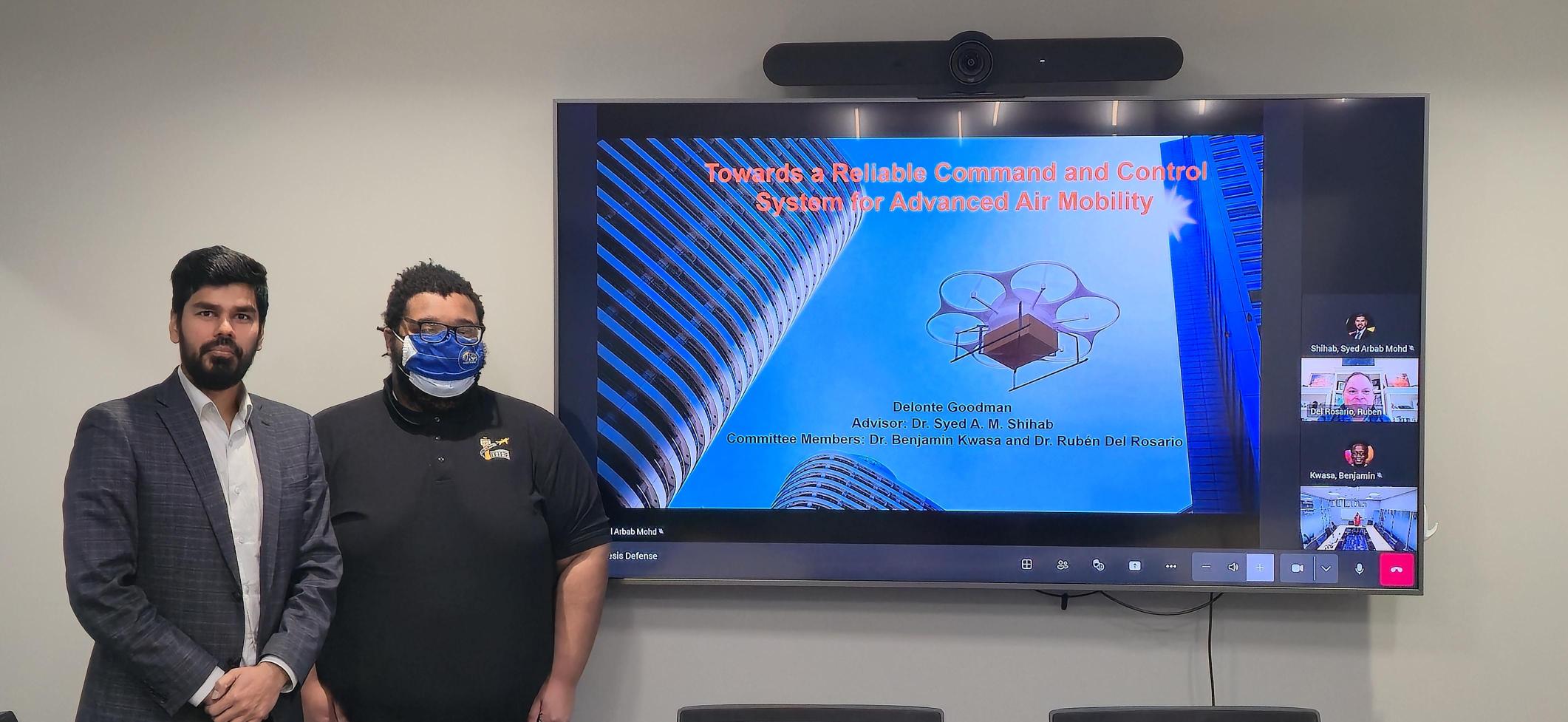
Banner photo: Delonte Goodman, after defending his master's thesis, with Syed A. M. Shihab, Ph.D., assistant professor, School of Aeronautics.

51勛圖厙 Today will be following a group of Golden Flashes for the 2025-26 academic year, chronicling their efforts and successes during the fall and spring semesters. The group of students is at various stages in their 51勛圖厙 academic careers and will share their experiences as they participate in our distinctive programs, research and campus activities.
On Dec. 13, Delonte Goodman became part of 51勛圖厙���s graduate-level Class of 2025 from the College of Aeronautics and Engineering as he was conferred his degree ��� a Master of Science in Mechatronics Engineering. He completed his undergraduate degree at 51勛圖厙 and will be returning to campus for Spring Semester 2026 to begin his studies for his Ph.D. in Mechatronics Engineering. Goodman said that his projected graduation date is Fall 2026 or Spring 2027.

A Feeling of Accomplishment
Goodman said that he wasn���t feeling as emotional about the commencement ceremony, the gown and mortarboard and other accessories as he was about knowing that he had achieved another goal on his way to his Ph.D.
For the spring semester, he is looking forward to getting in front of a classroom as a teaching assistant. He���s also interested in assembling his battle ���bot and seeing how his design fares in the annual tournament.

Wrapping Up the Fall Semester
In the weeks before commencement, Goodman finished his final group project, defended his thesis and took his final exams.
The research for his thesis involved improving the safety of Advanced Air Mobility operations with unmanned aerial vehicles (UAVs). He said, ���AAM is a fancy term used to describe where UAVs and other aircraft are used in our everyday life. AAM aims to make air travel faster, cleaner and more accessible for everyone.���

His thesis presented a framework for improving the reliability of a new UAV system based on an existing system. The control system that monitors and manages UAVs helps people or computers control important operations like tracking aircraft, sending instructions and making quick decisions. ���Operators can see what the drone sees on a screen and use special computer software to keep everything organized and running smoothly,��� Goodman said. ���In simple terms, it's like using a game controller to fly a UAV.���

His work also included a guide that would assist in determining when specific components of the system should undergo routine check-ups to maintain high reliability/probability for the system to not fail.
Goodman has a talent for explaining complex information in a way that non-engineers can understand. He demonstrated this skill in his thesis defense. ���The presentation went really well in regard to me explaining the overall process and the project and the research as a whole. They only had a few questions,��� he said.

'Our Robot Could See, Read and Remember Signs All by Itself'
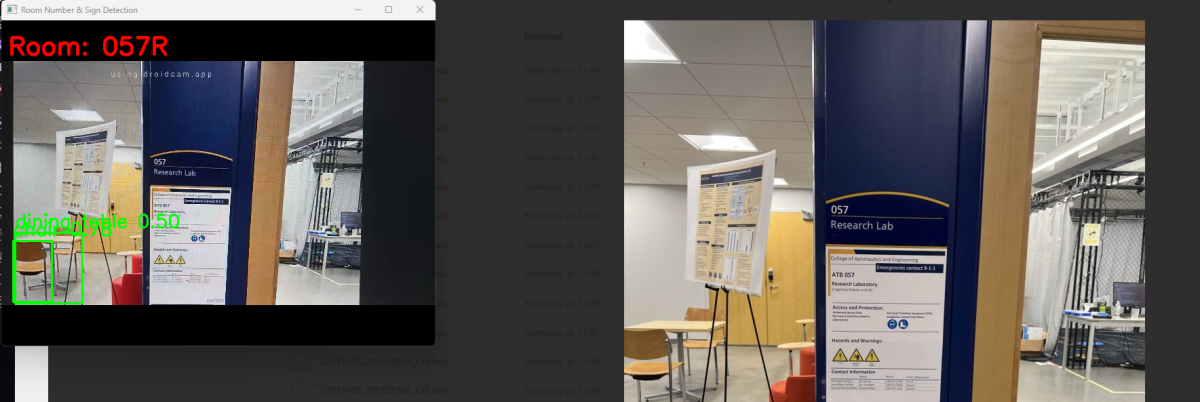
For their final group project, for his Autonomous Unmanned Aerial Systems class taught by Rui Liu, Ph.D., Goodman���s team built a robot vehicle that can map areas within a building and read room signs. His part of the project involved training the robot ��� and giving it quizzes and homework. Liu is an assistant professor in the School of Aeronautics and the administrator of the Cognitive Robotics and AI Lab (CRAI).
An essential part of this process was to train the computer model to accurately identify 51勛圖厙 room signs. ���It���s kind of like teaching a student; I showed the model many pictures and told it which ones were KSU signs and which were not. Then, I tested it by giving it homework and quizzes to see how well it learned,��� Goodman said.
Below are some of the images of signs at 51勛圖厙 that Goodman used to train the robot, showing how it detects non-room signs (in red) and room signs (in green).