

How do animals cope when oxygen levels suddenly drop? That question is at the center of research led by Sangeet Lamichhaney, Ph.D., associate professor and MA coordinator in the Department of Biological Sciences, whose team has assembled the first complete genome of the black redstart, a small mountain bird that regularly travels between high and low elevations. The work, recently published in , provides a foundational resource for studying how species respond genetically to rapid environmental change.
���We thought the black redstart would be an excellent model to understand acute hypoxia exposure because they are traveling within high and low altitudes all the time,��� Lamichhaney said.
The study aligns with Lamichhaney���s broader research focus on species adaptation to novel environments, a topic his lab has explored across species and continents, from the Himalayas to the Gal獺pagos Islands.
A ���mountaineer bird��� with a genomic first
At high elevations, oxygen levels are significantly lower, a condition known as hypoxia. In humans, long-term residents of high-altitude regions such as the Himalayas or Andes show genetic adaptations that help their bodies function in less oxygen environments. Similar patterns have been documented in birds that live permanently at high elevations. The black redstart, however, does not stay in one place.
���There are some birds that stay at a particular elevation throughout their lifetime,��� Lamichhaney said. ���The black redstart, however, does extensive altitudinal migration, i.e., stays at a high elevation during the breeding time in the summer, but outside of the breeding time, it can rapidly go down and live as low as 1,000 meters.���
Because of this seasonal movement, the species offers a rare opportunity to study acute exposure to hypoxia, and short-term physiological stress, rather than lifelong adaptation.
To enable that work, Lamichhaney���s lab first had to do something no one had done before. The team built the bird���s genome from scratch.
���There was no genome of this bird available before,��� Lamichhaney said. ���Now we have the genome of a very unique bird, and that will be a great resource for future work.���
Beyond hemoglobin: what genes matter most?
Much of what scientists know about high-altitude adaptation centers on hemoglobin genes, which influence how oxygen is transported in the blood. While those genes remain important, Lamichhaney said they are only part of the story.
���People have discovered that hemoglobin genes are the major factor for hypoxia adaptation,��� Lamichhaney said. ���But we are pretty sure that there are other genes as well that are major players here.���
With the newly assembled genome, researchers can now track gene expression, which refers to which genes are turned on or off, as birds move between elevations.
���If a particular gene has to be more functional at high elevation, it expresses more,��� Lamichhaney said. ���At low elevation, the same gene might not be expressed as much.���
Future studies will compare gene activity when the same species is living at different elevations at different time, rather than comparing entirely different species living for their life time at a particular elevation. This represents a key advance for the field.
Supercomputers, collaboration and student training
Assembling a genome is no small task. Even with modern sequencing technology, the process requires massive computational power and specialized expertise.
���The biggest challenge is computational,��� Lamichhaney said. ���If you don���t have enough resources, the assembly process can take months to years.���
To meet that challenge, Lamichhaney has built a dedicated supercomputing resources in his lab after joining 51勛圖厙 in 2019, supported by university funding and external grants. His team also relied on the , a state-funded resource available to researchers across Ohio.
Equally important, he said, are the people behind the data.
The paper���s lead author, Prashant Ghimire, is a Ph.D. student who joined the lab as an ornithologist with little computational background.
���In the last four years, he has been learning all these new computing techniques by himself,��� Lamichhaney said. ���Bioinformatics is a new field, but we need students who have these skills both in biology and informatics.���

The project also depended on international collaboration. Fieldwork and sampling were conducted in China with the help of local scientists, including Professor Nan Wang, a field biologist from Beijing Forestry University in Beijing, China with decades of experience working in Tibet.
���Local knowledge about a place is critical,��� Lamichhaney said. ���That local collaboration is very important and comes into play for such work.���
Moving birds and environments on purpose
Building the genome is only the first step.
In ongoing follow-up studies, Lamichhaney���s team is conducting reciprocal transplantation experiments. In these experiments, birds are physically moved between high and low elevations to study how their genes respond over time.
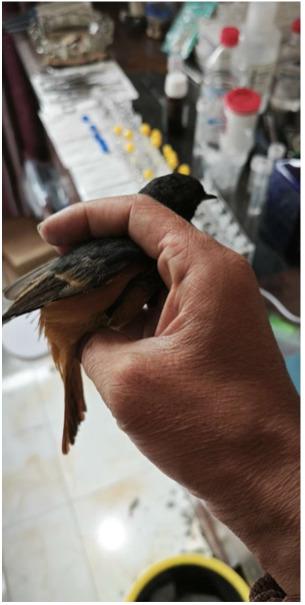
The process involves carefully capturing birds using mist nets, acclimating them in protective enclosures and transporting them by vehicle between field sites. Blood samples collected over several weeks allow researchers to observe how gene activity changes in response to new oxygen levels.
A foundation for future discovery
While the genome publication marks a major milestone, Lamichhaney emphasized that it represents the beginning, not the end, of the research. He said getting the genome was already a big challenge, but it���s just the first step in the bigger picture.
By identifying which genes respond most strongly to environmental change, the work may eventually help scientists predict which species are more vulnerable as habitats shift.
���This work has very important conservation importance,��� Lamichhaney said. ���If you know how the species responds to environmental change, you can predict how they are going to change in the future.���
###